
The Many Selves We Carry

Why having different part of ourselves does not mean we are broken.
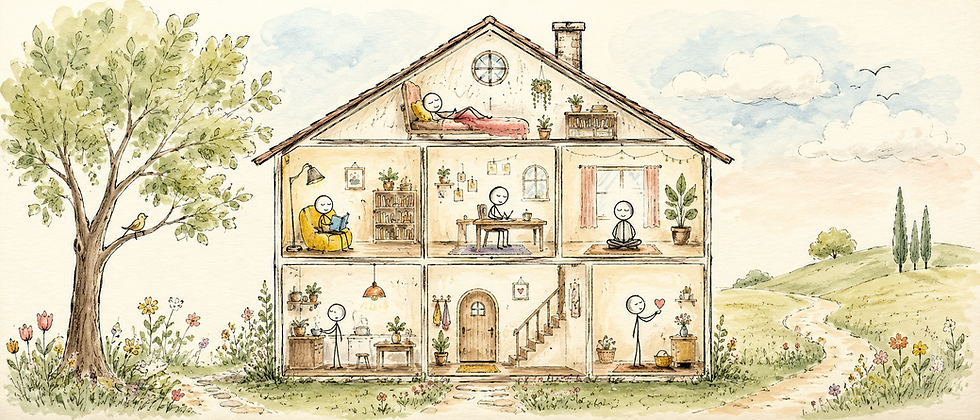
Imagine walking through a house you have lived in for years and discovering that it contains more rooms than you remembered.
Some are bright and orderly. One is prepared for company, with the pillows arranged and everything in its proper place. Another holds unfinished projects, old photographs, and boxes you have been meaning to sort through for approximately half your natural life.
There may be a room where anger paces.
A room where grief sits quietly by the window.
A room where a frightened child still listens for footsteps in the hall.
There is also a highly competent room with a calendar, a clipboard, and several backup plans in case everyone else proves unreliable.
All of these rooms belong to the same house.
We tend to think of ourselves as one consistent person moving through the world with one clear set of feelings, beliefs, and intentions. Yet most of us know the experience of wanting two opposing things at once.
We want to be seen, and we want to hide.
We want closeness, and we want everyone to please give us a little room.
We want to speak honestly, and we immediately begin composing a softer, more acceptable version.
We long for rest, while another part insists that rest must first be earned through a heroic and frankly unreasonable level of productivity.
These contradictions do not mean we are false, unstable, or broken.
They reveal the many selves we carry.
The Inner System
Internal Family Systems, often called IFS, is a therapeutic model developed by Richard Schwartz. It begins with a simple and deeply compassionate idea: the mind is naturally made up of parts.
These parts are not separate personalities. They are aspects of us that formed around particular experiences, needs, fears, relationships, and responsibilities.
There may be a competent part, a frightened part, a caretaker, a critic, a rebel, a peacemaker, a performer, and a child who still hopes someone will notice what she needs.
There may also be an adult who has become very skilled at pretending she needs nothing.
Some parts try to manage life by keeping everything controlled and orderly.
Some work very hard to please others.
Some criticize us before anyone else gets the chance.
Some withdraw.
Some become angry.
Some numb.
Some overwork, overthink, overeat, overexplain, or compulsively solve problems that may not actually be solvable.
A part that looks unreasonable from the outside may be carrying out a very old assignment.
The inner critic may believe relentless self-scrutiny will prevent failure.
The people-pleasing part may believe belonging depends on remaining agreeable.
The controlling part may believe that if it loosens its grip for even a moment, everything will fall apart.
The hypervigilant part may still be living in a world where danger could arrive without warning.
Even the parts we dislike most often began with a protective intention.
Their methods may be outdated. They may be exhausted. They may create difficulties in our present lives. But somewhere along the way, they learned that this was how to keep us safe.
When Protection Becomes a Burden
A strategy that once helped us survive can later begin to limit us.
The child who learned not to ask for too much may become the adult who cannot identify what she wants.
The person who became highly competent during chaos may struggle to trust anyone else enough to share responsibility.
The part that learned to stay quiet may later feel invisible.
The part that kept peace in the family may become deeply uncomfortable with conflict, even when conflict is necessary.
The part that stayed alert may continue sounding the alarm long after the danger has passed.
This is one of the most painful things about protective patterns: they often remain loyal to circumstances that no longer exist.
The part is still responding to an old environment, an old relationship, an old wound, or an old version of who we had to be.
It does not know that we have grown.
It does not know that we now have choices.
It does not know that we are no longer entirely dependent on the approval, stability, or emotional availability of someone else.
It may need help learning that the world has changed.
The Self Beneath the Noise
IFS also describes something called Self.
The word can sound grand or spiritual, but the idea is practical. Self is the presence within us capable of meeting our inner experience with curiosity, compassion, steadiness, courage, and perspective.
It is the voice that can say:
Something in me is frightened.
A part of me is angry.
A part of me wants to disappear.
A part of me is working very hard to make sure no one is disappointed.
That language matters.
There is a meaningful difference between saying, “I am a failure,” and saying, “A part of me feels like a failure.”
The first collapses our entire identity into one painful belief.
The second creates a little space.
Not distance in the sense of denial. Not detachment in the sense of not caring. Just enough room to become interested in what is happening inside us.
From that space, we can ask:
What is this part afraid would happen if it stopped doing its job?
What is it trying to prevent?
How old does this part feel?
What does it need me to understand?
These questions are very different from the ones we usually ask.
Why am I like this?
Why can’t I get over it?
What is wrong with me?
Why do I keep doing this?
Those questions rarely make frightened parts feel safer.
They usually make them dig in.
You Contain More Than One Truth
One of the most freeing things we can learn is that opposing feelings can both be true.
You can love someone and know the relationship is not good for you.
You can feel grateful and resentful.
You can be strong and tired.
You can forgive and still need distance.
You can understand why someone behaved as they did and still hold them accountable for the harm they caused.
You can want change and fear it.
You can miss a person you do not want back in your life.
You can be healing and still have difficult days.
We often create unnecessary suffering by insisting that one truth must cancel out the other.
If I am angry, perhaps I am not compassionate.
If I still feel grief, perhaps I have not healed.
If I need a boundary, perhaps I am unkind.
If part of me wants to leave, perhaps the love was never real.
Human experience is rarely tidy enough to fit into one emotional category.
We contain more than one truth because we contain more than one history, one need, one fear, and one hope.
An Older Understanding of the Self
Long before modern psychotherapy, the Upanishads and other yogic texts described the human being as layered.
They spoke of the body, the breath, the mind, the personality, the roles we inhabit, and a deeper awareness that can observe all of these without being reduced to any one of them.
We do not have to adopt a religious belief system to find this useful.
The secular version is simple:
There is a difference between what we are experiencing and the awareness that notices the experience.
There is a difference between the anxious thought and the part of us that can recognize, “My mind is predicting danger.”
There is a difference between shame and the awareness that can say, “Something in me feels unworthy right now.”
There is a difference between anger and the capacity to become curious about what the anger is protecting.
We are not only the storm.
We are also the one who notices the weather changing.
This does not make pain disappear, but it changes our relationship to it.
Welcoming What Arrives
In Rumi’s poem The Guest House, in a well-known English rendering by Coleman Barks, he writes:
“This being human is a guest house.”
The poem invites us to welcome even painful emotions as visitors rather than intruders to be driven away.
The metaphor is not exactly the same as the inner system described by IFS. Some experiences move through us like temporary guests, while our protective parts may have lived in the house for many years.
Still, both perspectives offer the same gentle correction: we do not become whole by declaring war on whatever appears within us.
Some feelings need room to pass through.
Some parts need a chair, a cup of tea, and the reassurance that they no longer have to guard the house alone.
Healing may begin when we become less frightened of our own interior world.
Healing Is Not an Eviction Notice
Many people begin therapy hoping to get rid of a part of themselves.
They want to eliminate anxiety, silence the critic, stop feeling anger, erase grief, become less sensitive, or permanently remove the part that keeps choosing the wrong person.
This is understandable.
Some parts are loud. Some are exhausting. Some have very poor timing.
But healing is rarely an eviction process.
The goal is not to banish parts of ourselves. It is to help them become less burdened and less extreme.
The critic may still have discernment, but it no longer needs to be cruel.
The caretaker may still be loving, but she no longer has to abandon herself.
The angry part may still protect boundaries, but it no longer has to burn down the building to make its point.
The vigilant part may still notice risk, but it no longer needs to sound the alarm every time someone takes too long to text back.
The frightened part may still need comfort, but it no longer has to run the entire inner household.
Healing allows parts to take on healthier roles.
It helps them learn that they are no longer alone.
Becoming More Whole
Wholeness does not mean becoming one seamless, uncomplicated self.
It does not mean never feeling conflicted.
It does not mean responding to every situation with perfect calm and spiritual maturity while soft music plays somewhere in the background.
Wholeness may simply mean becoming more able to remain present with ourselves.
It may mean noticing the critic without immediately obeying it.
It may mean comforting the frightened part instead of shaming it.
It may mean allowing anger to deliver its message without handing it the car keys.
It may mean recognizing when an old protector is responding to a present-day situation as though it were still 1987.
The many selves we carry do not have to compete for control.
They can become part of a larger internal relationship—one built on curiosity rather than judgment, compassion rather than force, and leadership rather than fear.
You are not only the part that worries.
You are not only the part that pleases, performs, withdraws, overfunctions, or braces for disappointment.
You are also the one who can turn toward those parts and listen.
And sometimes, that is where healing begins.
A Moment of Reflection
Take a quiet moment and notice which part of you has been most present lately.
Is it the part that worries?
The part that keeps everyone else comfortable?
The part that wants to withdraw?
The critic, the caretaker, the performer, the peacemaker, or the one who is simply tired?
Rather than trying to correct or silence it, ask:
What are you trying to protect me from?
What are you afraid might happen if you stopped working so hard?
When did you first learn that you had to do this job?
What would you like me to understand?
What do you need from me now?
You do not have to solve anything immediately.
Begin by listening.
Sometimes a part becomes less forceful when it realizes it no longer has to carry its burden alone.
Every room belongs to the house. But no single room is the whole of who you are.
Janet Nash, MSW, LISW-S, Yoga Therapist, CCTP, is a psychotherapist and the founder of Interiority Wellness. She writes about mental health, trauma, relationships, creativity, nature, and the lifelong practice of coming home to yourself.


